
Searching for a Fayette County Warrant
The first public channel is the Fayette County Sheriff's Current Active Warrants page. Its wording matters: the list covers people with “possibly active” warrants held by law-enforcement agencies in Fayette County. It does not certify that every current warrant is present. Start with the full legal name. Search without a charge or date range first, since a narrow filter can hide a relevant result.
A complete Fayette County warrant lookup touches each available channel. Keep the case number ready when one is known. Date of birth is not a field on the sheriff form, though the clerk may ask for it to distinguish people with similar names. A lawyer can advise on a response before a person reports to court or law enforcement.
- Search the sheriff page by name, then repeat without charge and date filters.
- Review the public case docket in Iowa Courts Online for a warrant, missed setting, bond, or disposition entry.
- Call the sheriff at (563) 422-6067 and the Fayette County Clerk of Court at (563) 422-5694 for confirmation.
- Use the sheriff's mailed Records Department request when open material is missing from the public tools.
- Route city parking matters to the city clerk and municipal infractions to Iowa District Court. The IOWA System is not public.
Fayette County's Four Search Filters
The sheriff interface keeps the public search simple. It has fields for Name, Charge(s), Date Issued From, and Date Issued To, plus Submit and Reset. It does not publish wildcard rules, a required-field marker, a date-of-birth box, or a warrant-number search. That makes the tool a good lead generator for a self-check, but a poor place to settle a close identity match on its own.
The official sheriff interface confirms the four-filter layout. Use it without copying or republishing any result rows.
Warrant Search Fields Explained
Each Fayette County warrant search field narrows the public list, but no field proves identity. Name is the broad entry point. Charge is free text, so a slightly different label can cause a miss. The issue-date limits are optional in appearance and have no posted format guidance. Search again with fewer limits before concluding that the form has no match.
| Field Label | Type | Required | Notes |
|---|---|---|---|
| Name | Text | Unspecified | No exact or partial-match rule is posted. |
| Charge(s) | Text | Unspecified | Free text, with no published option list. |
| Date Issued From | Date | Unspecified | Leave blank when the date is not known. |
| Date Issued To | Date | Unspecified | An end date can exclude a new entry. |
| Submit / Reset | Buttons | N/A | Runs the filter or clears every field. |
Repeat Fayette Searches Without Dates
Myth: A narrow date search is more reliable. Fact: it is only more selective. A warrant may be older than expected, tied to a missed setting, or entered after the date range chosen. The sheriff does not post an update cadence, so the date shown is not a live status history.
Run the name by itself, then add the charge only if needed. If a row appears, call the sheriff for current status and the issuing source. If no row appears, check the court docket and call the clerk. That fallback matters because a new, sealed, confidential, juvenile, or other-agency record may not appear in an ordinary public list.
What a Warrant Search Shows
A sheriff result row exposes name, date issued, charge or charges, and bond amount. The detail template also labels warrant number, warrant type, date issued, bond amount, and age. No official Fayette warrant-number format is published, so a safe sample is simply case or warrant number, not an invented local code. The public row does not visibly provide the issuing judge, serving agency, address, date of birth, or full status history.
| Warrant Number | A detail label, with no published Fayette format. |
|---|---|
| Charge / Offense | The accusation linked to the public entry. |
| Issuing Court | Not a visible result column; confirm with the clerk or sheriff. |
| Bond Amount | A listed amount or hold that must be verified. |
| Status | The page says “possibly active,” not certified active. |
Iowa Courts Online Adds Fayette Context
The Iowa Courts Online case search is the public docket route for the unified Iowa District Court. It may show a case number, charges, filings, hearings, judgments, missed settings, payment information, or a warrant event when those items are public. It is not the law-enforcement warrant network and does not replace a sheriff confirmation.
Iowa's search help requires at least two letters of the last or firm name. Other fields are optional. AND requires both name terms, OR allows either, and a percent sign works as a wildcard. Some links or details are available only through a clerk terminal or subscription. Use the Fayette county filter to reduce unrelated matches, then take the case number to the clerk.
Common Names Need Fayette Confirmation
A name match should never be treated as identity proof. The sheriff result row does not show a date of birth or address. Age can appear in the detail template, but that still may not resolve a common-name match. Do not confront anyone or take action based on a public row.
Safe match check: Call the sheriff, give the exact name and any case number, and answer only the identity questions the agency requests.
The clerk can match a public case record to a case number and explain what public docket information exists. Ask whether the court record shows a current warrant event and which court step follows. A lawyer should handle legal strategy, including any motion or planned surrender.
Where to Check Fayette County Warrants
The sheriff holds the public county-facing warrant list and confirms law-enforcement status. The Fayette County Clerk of Court keeps Iowa District Court case and docket information at 114 N Vine Street, Suite 200, West Union. The jail channel confirms custody and bond details at the sheriff number, extension 245. A records request can seek specific open sheriff material by mail to the Records Department, PO Box 518, West Union; reasonable costs may require prepayment.
Iowa has no separate modern municipal or justice-of-the-peace court in Fayette County. Municipal infractions file through Iowa District Court. City parking fines remain with the city clerk. City police can route local questions, but the court and sheriff remain the confirmation points. The IOWA System connects more than 450 criminal-justice agencies, yet it is restricted to agencies and is not a public statewide warrant lookup.
A Fayette Records Request Fallback
Use a records request when a specific sheriff record is needed and the public list is silent. The Sheriff's Records Requests instructions direct mail to the Records Department. Identify the record precisely, include a phone number or email, and focus the request on the status or file needed. A broad demand for a roster is not needed for a personal status check.
The sheriff may charge reasonable costs and ask for payment before release or at pickup. Confidential records remain withheld. A request is therefore an access channel, not a way around sealed, juvenile, or investigation-based limits. For a court filing or docket event, contact the clerk instead because the lawful custodian depends on which office holds the record.
Restricted Warrants and Access Rules
The Iowa Open Records Act, Iowa Code chapter 22, supports access to government records subject to legal exceptions. Iowa Code section 22.7 protects specified confidential records. Juvenile court records are generally confidential under Iowa Code chapter 232, while a sealed warrant or application stays outside an ordinary public search. An active investigation may also limit disclosure.
Key Rules:
Sealed warrants and applications are not exposed merely because a public user searches.
Juvenile Fayette County warrant records are restricted under Iowa law.
A newly issued or confidential warrant may be absent, so no result is not proof that none exists.
Fayette County Office Search Routes
The official Fayette court page identifies the clerk, scheduling contact, payment route, parking, and accessibility information.
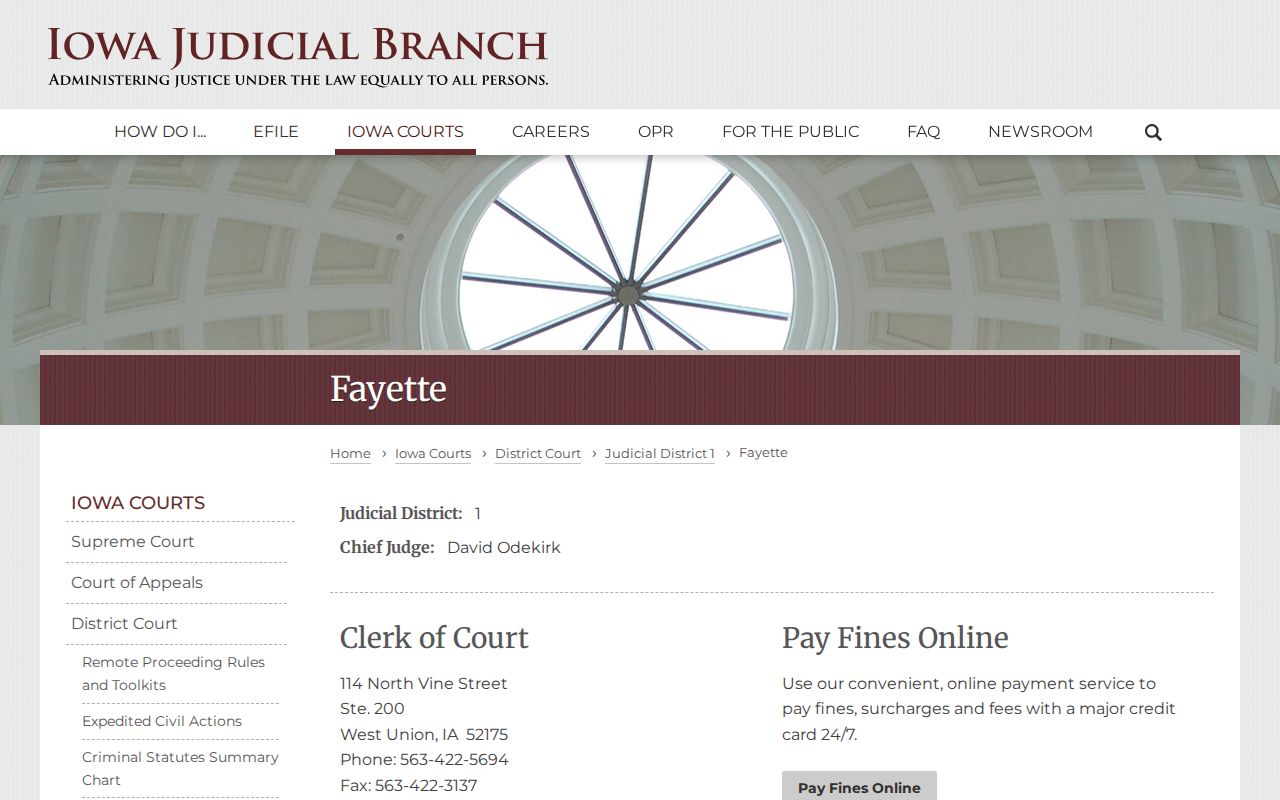
The image helps distinguish the public court-file route from the sheriff's possibly-active list. A docket question belongs with the clerk, while a current service or custody question belongs with the sheriff.
The official sheriff contact page shows the office contact form and published hours.
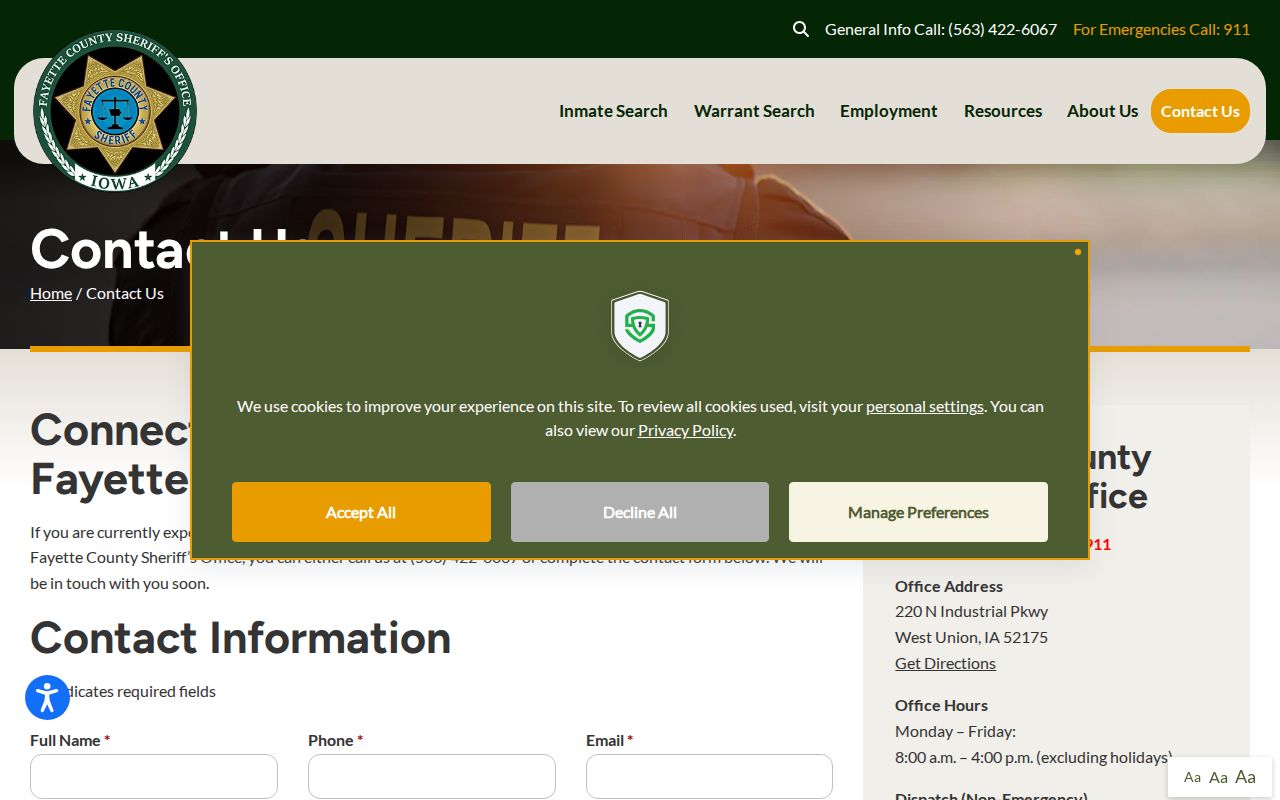
That form is a general contact route, not a warrant application or guaranteed status check. For time-sensitive confirmation, use the published sheriff phone number and ask which office owns the record.