
Fayette County Bench Warrants Explained
A bench warrant is court-issued arrest process tied to an existing case, order, or duty. Fayette triggers include a missed criminal hearing, arraignment, sentencing, probation setting, contempt or show-cause matter, and another required appearance. Iowa Code section 804.1 also permits a magistrate to issue a warrant for the original offense when a person who received a citation willfully fails to appear.
Iowa sources use “bench warrant,” “failure to appear,” and “warrant for arrest.” Capias and capias pro fine are not standard local terms. Unpaid debt alone is not proof of a warrant. The key facts are what the court ordered, whether an appearance was required, and what the docket shows afterward.
Fayette's FTA-to-Warrant Timeline
The path starts with an existing case, citation, or order. The court sets an appearance or compliance step. If the person does not appear, a judge or magistrate reviews the case and may issue process. Law enforcement then enters and may serve the warrant, while the clerk records later court action.
- A complaint, citation, judgment, or order creates the case.
- The court sets a hearing, sentencing, or compliance date.
- A missed duty is entered in the docket.
- A judicial officer decides whether to issue a warrant.
- Service, surrender, recall, or quash changes the status.
The result is not automatic in every case. Only the issuing court can establish what happened in a specific matter.
How Fayette County Bench Warrants Are Issued
A district judge, district associate judge, or judicial magistrate acts within Iowa District Court. The judicial officer reviews the missed duty and may order arrest and production before court. The clerk keeps the file but cannot cancel a judge's warrant. A court order is needed to recall, quash, or modify it.
After issuance, the warrant may appear on the Fayette sheriff's “possibly active” list, in a public docket, and in restricted law-enforcement systems. The IOWA System is for criminal-justice agencies, not public users. A public list hit still needs direct confirmation.
No Fayette Municipal Warrant Desk
Myth: a city citation requires a separate municipal bench-warrant portal. Fact: Iowa abolished former mayor's, municipal, police, and justice-of-the-peace courts. Municipal infractions in Fayette County file with the district-court clerk and are heard by an Iowa judicial officer.
City parking tickets are narrower. Iowa Courts Online says those fines are not listed or payable there, so contact the city clerk. If court process arose, use the Fayette County Clerk of Court and the district-court docket. City police can route a local question but cannot replace the issuing court.
Bench Warrants and Arrest Warrants Compared
A bench warrant often follows a missed duty in an existing case. An arrest warrant generally begins with a sworn complaint and probable-cause review for an alleged offense. Both authorize arrest and may lead to booking and an initial appearance. A search warrant is different because it authorizes a search.
| Feature | Bench Warrant | Arrest Warrant |
|---|---|---|
| Trigger | Missed appearance or court duty | Probable cause of an offense |
| Who Issues It | Judge or magistrate in the case | Magistrate after sworn review |
| Underlying Case | An existing matter | An alleged charged offense |
| How It Clears | Appearance, recall, quash, or service | Service or surrender, then court process |
Jury Absence Takes Another Path
Missing jury service differs from missing a criminal hearing. Iowa jury materials describe an order to appear and explain why the person should not face contempt. A contempt finding may result in a fine, incarceration, or both. It should not be casually labeled a standard criminal bench warrant.
The Iowa Judicial Branch jury page gives the official warning.
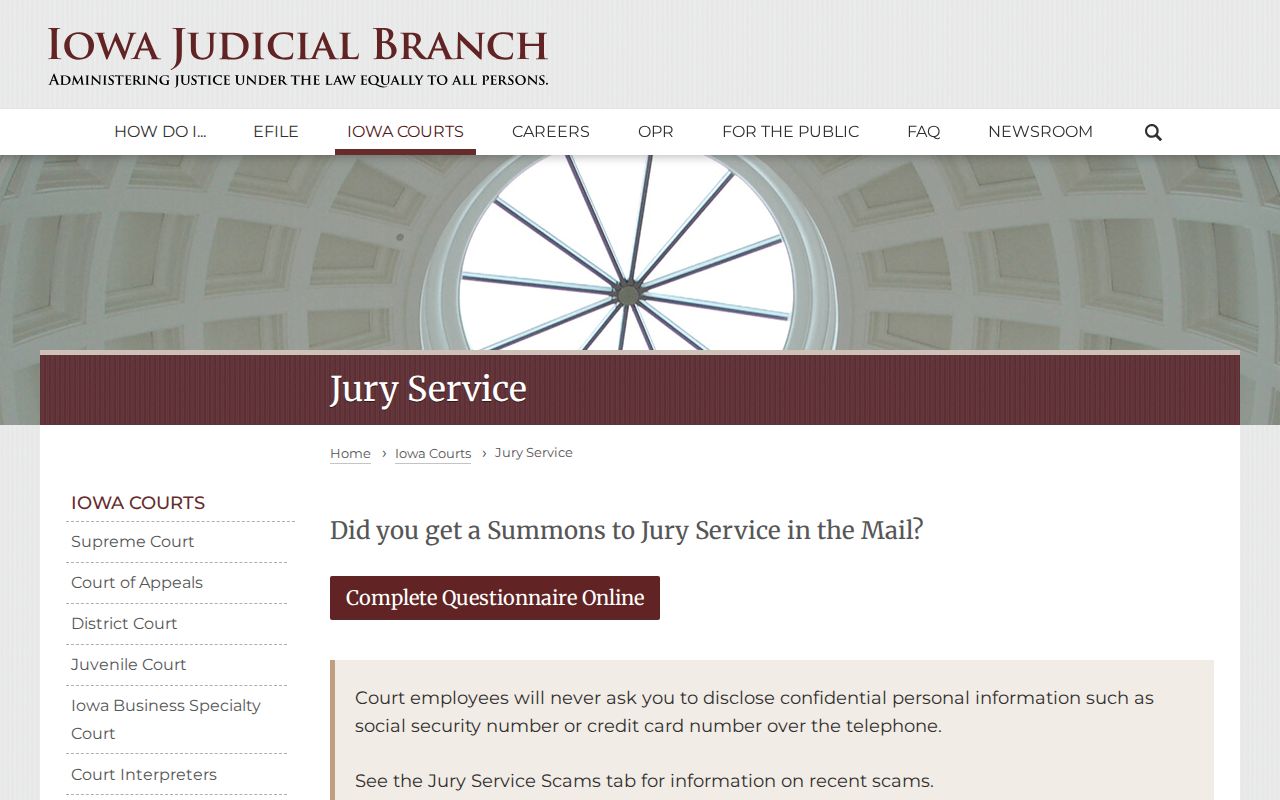
The source shows why a missed summons should be addressed with the court, not guessed from a sheriff search.
Call the Fayette Clerk First
Contact the Fayette County Clerk of Court at (563) 422-5694 and a lawyer before reporting in person. Give the case number and ask whether the public docket shows failure to appear or a warrant. Ask whether the judge requires a motion, reset hearing, personal appearance, or coordinated surrender. Legal strategy belongs to counsel.
Before reporting: Call the sheriff to confirm whether the person should go to court, the sheriff's office, or the correctional center.
No special Fayette walk-through window was located. Verify any bond at (563) 422-6067, extension 245.
Fayette Probation and Sentencing Warrants
The sheriff schema includes violation-of-probation and failure-to-appear-awaiting-sentencing style categories. Those labels describe types of public records, not any individual. A sentencing warrant can follow a conviction when the person fails to appear for sentencing. A probation warrant can follow an alleged breach that the court must address.
Bond may be set, withheld, or reviewed by a judicial officer based on the order and law. Do not infer terms from the charge label. Ask the clerk for the public docket, the sheriff for current enforcement and bond data, and counsel for the response. The Iowa Rule 2.36 failure-to-appear form commands arrest and return to district court but does not set one universal bond amount.
Fayette Bench Warrant Access Channels
The sheriff search is the fastest public starting point, but it is only one channel. Iowa Courts Online supplies public docket context. The Clerk of Court confirms the case record and routes court filings. The sheriff and jail confirm enforcement and bond logistics. A precise mailed request to the sheriff's Records Department can seek open material that is not on the web.
The state IOWA System cannot be searched by the public. Juvenile, sealed, and other confidential records may be withheld. If a city parking ticket is the concern, contact that city clerk; if a municipal infraction reached court, use Iowa District Court. Together, these channels prevent a missing web row from being mistaken for a final answer.
Resolving a Fayette County Bench Warrant
Resolution begins with confirmation of the case and current order. Counsel may seek recall, quash, rescission, or a reset. The judge decides. A voluntary surrender may instead lead to booking, initial appearance, conditions, and bond review. Bond secures release and a future appearance; it does not resolve the charge.
- Confirm the warrant, case, court, and bond terms.
- Ask counsel whether a recall or quash motion fits.
- Arrange any surrender through verified instructions.
- Attend the new setting and keep written proof.
Caution: Paying court debt alone may not clear the warrant. Confirm the new status with both court and sheriff.
What Fayette Cleared Status Means
Cleared is not the same as dismissal, acquittal, sealing, or erasure. It means the enforceable process was resolved or removed. The charge, judgment, probation term, fine, or next hearing may remain. Keep the signed order, bond certificate, payment receipt, or release paperwork.
Ask when the court record will update. Recheck Iowa Courts Online after processing time, then call the sheriff. If a public row remains, use the sheriff's proper correction or records channel and provide the court proof.
Finding the Court That Issued the Warrant
Iowa District Court is the unified issuing court. District judges hold broad jurisdiction. District associate judges hear assigned misdemeanor, scheduled-violation, and infraction matters. Magistrates handle simple misdemeanors, scheduled violations, infractions, complaints, initial appearances, and bond functions. Juvenile process is confidential.
Use the official Fayette court page or contact the clerk at 114 N Vine Street, Suite 200, West Union. The sheriff serves and confirms enforcement status. The issuing judicial officer controls recall.